
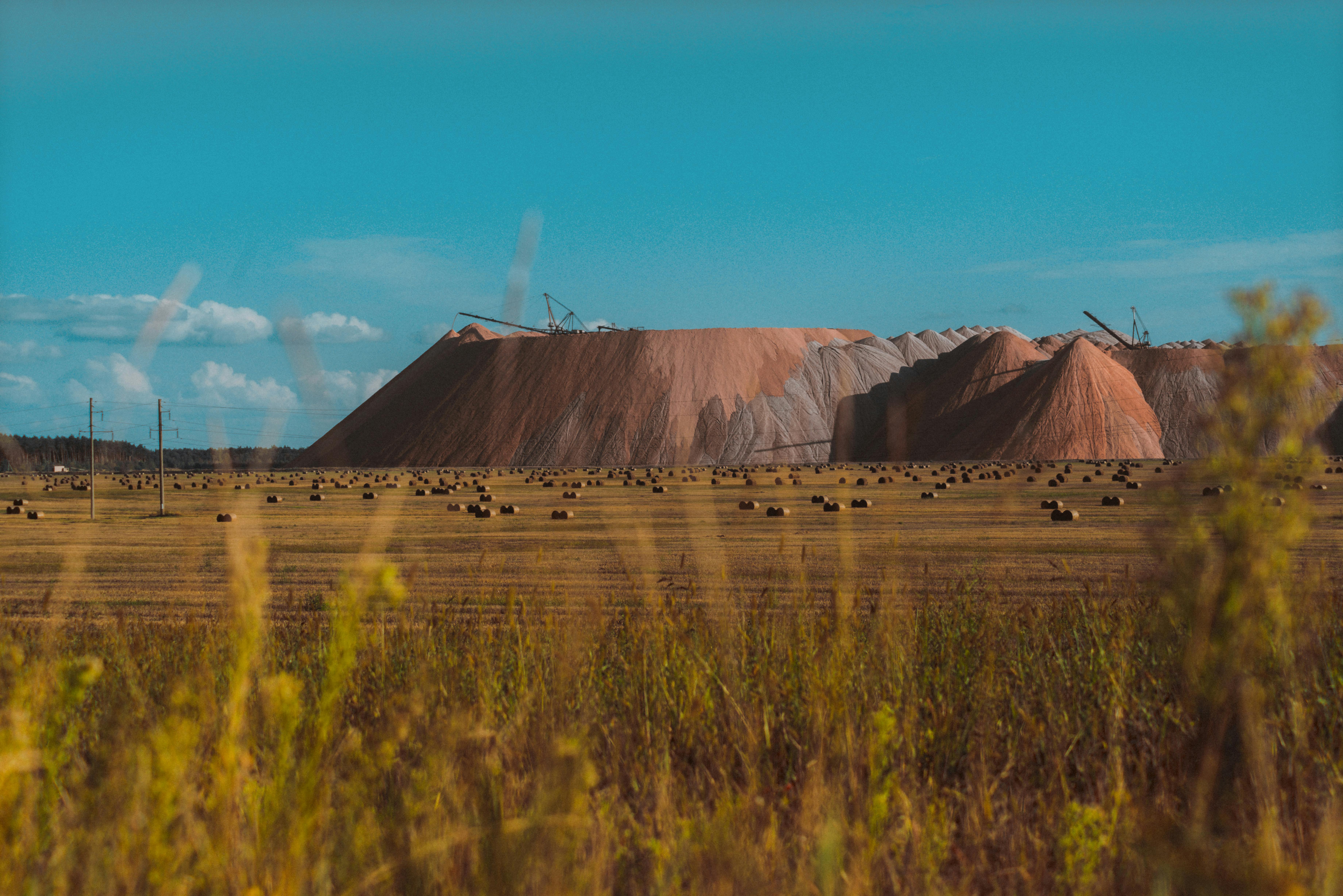
Some ore is too poor to justify building a processing plant. Heap leaching exists to extract value from exactly that material, and it works by accepting a worse recovery rate in exchange for a far lower cost.
The method is deliberately simple
Ore is crushed, stacked on an engineered pad with an impermeable liner beneath, and irrigated with a chemical solution that dissolves gold as it percolates downward.
The loaded solution collects at the base and is pumped to a recovery plant, where the gold is stripped out and the solution is returned to the top of the heap.
There is no fine grinding, no flotation circuit and no large mill building. The capital requirement is a fraction of conventional processing.
Recovery is incomplete by design
Solution cannot reach every gold particle in a coarse pile of rock. A meaningful portion of the contained metal is never recovered.
A mill would capture considerably more of it, but only after the ore has been ground finely enough for chemistry to reach each particle, which costs energy and equipment.
The comparison is therefore between recovering a large share of a small cost base and recovering nearly all of it at a much larger one.
It changes what counts as ore
Because the processing cost per ton is low, material with very little gold in it can still produce more value than it costs to move and treat.
That shifts the boundary between ore and waste. Rock that a mill-based operation would send to a dump can become feed for a leach pad.
The result is longer mine lives and larger reserves at the same deposit, achieved by lowering the threshold rather than finding more metal.
Time is part of the cost structure
Leaching a heap takes months, and metal continues to trickle out long after irrigation of a given lift begins. Cash comes back slowly.
That lag matters for financing, since the capital spent stacking ore is recovered over an extended period rather than in the following quarter.
Cold weather slows the chemistry further, which is why the technique suits warm, arid regions and performs poorly in hard winters.
Closure obligations extend well past mining
A pad must be rinsed and neutralized once leaching ends, and the site monitored afterward, with financial assurance typically posted to regulators in advance.
Those long-tail obligations are part of the true cost and appear in company accounts as reclamation provisions rather than operating expense.
Judging the method on its operating cost alone therefore understates it, which is why closure liabilities are examined alongside production figures.